English 11 · Reading R1 · Review draft
Read with a purpose
Skim for the main idea, scan for one detail, and let the topic sentence guide you.
Suggested pace: 35–50 minutes, at your pace. This is an estimate, not a time limit.
The question
Your friend sends you a long message about a school programme. Your teacher asks only: “What time does it start?” Do you read every word of the message?
Of course not. You hunt for the time and ignore the rest. But if a friend asks “What is the message about?”, you do something different: you let your eyes move quickly over the whole text to catch its general idea. Good readers change their speed to match their purpose. This lesson teaches the two speeds you will use most in the Grade 11 reading exam: skimming for the main idea and scanning for one detail, plus the paragraph skill that makes both easier: finding the topic sentence.
By the end, you should be able to skim a text and state its main idea in one sentence; scan a text and pull out a name, number, place or date; and find the topic sentence of a paragraph and separate it from its supporting details. These are the first three reading outcomes of the Grade 11 English curriculum.
You need only basic English reading. No grammar rules are tested here. Write your answers on paper before opening any explanation panel.
Starting check
D1. A notice says: “Football practice: Friday, 4 p.m., school ground.” On which day is the practice?
D2. In that notice, is “school ground” the main idea or a detail?
D3. Is the main idea of a paragraph usually carried by one sentence, or by every sentence equally?
D4. True or false: good readers always read every word at the same speed.
Check the starting questions
D1: Friday. Your eyes searched for a day and stopped when they found it; that was scanning. D2: a detail; the main idea is that football practice will happen, and the ground only tells you where. D3: usually one sentence, called the topic sentence. D4: false. Good readers slow down, speed up or search, depending on what they need.
If D1 and D2 felt easy, you already scan without naming it. If D3 surprised you, Idea 3 explains how paragraphs are built. Keep reading: everything here starts from the beginning.
Idea 1: reading has speeds, and you choose
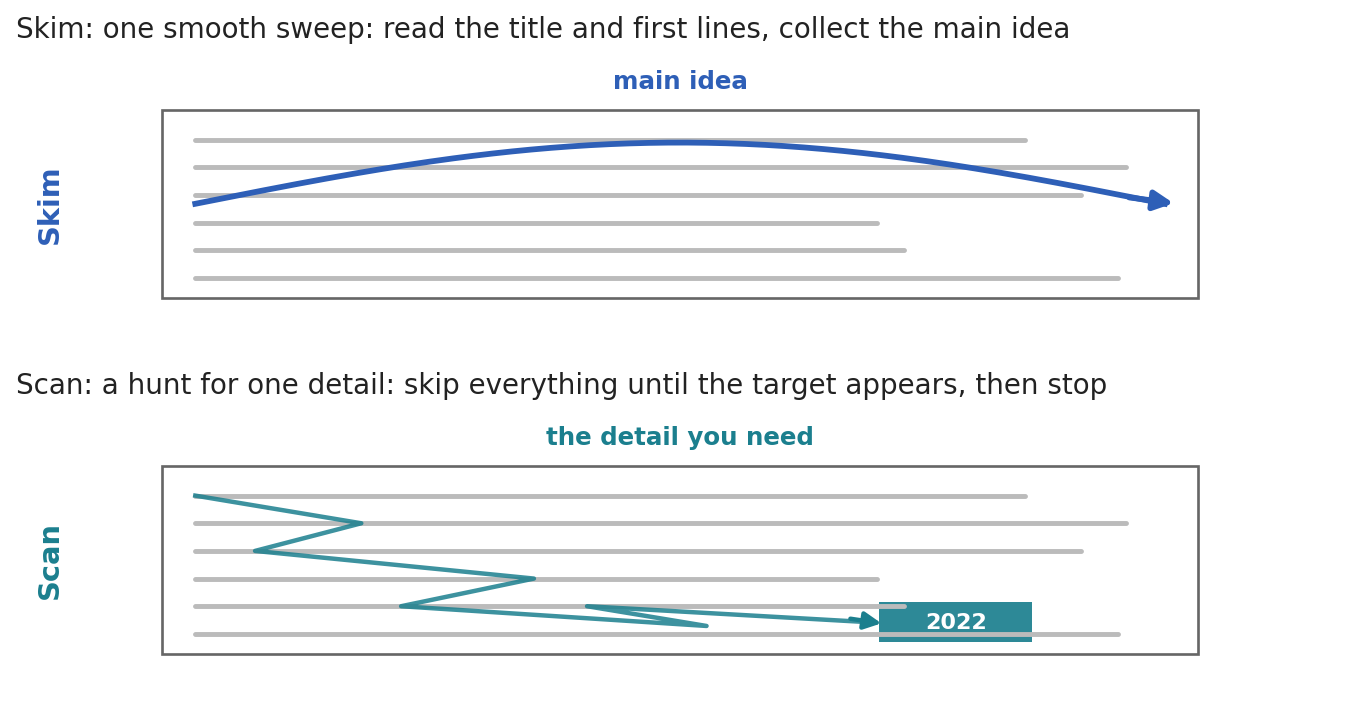
There is no single correct way to read. There are different tools, and the purpose chooses the tool. Skimming means moving quickly over the whole text to collect its main idea: you read the title, the first and last lines of paragraphs, and repeated words, and you let the small details pass. Scanning means searching for one specific detail, a name, a number, a date, a place, and ignoring everything else until you find it.
Both are real reading. An exam question that asks “What is the passage mainly about?” rewards skimming. A question that asks “When did the library open?” rewards scanning. Choosing the wrong tool wastes time: scanning for a main idea gives you a detail, and skimming for a date gives you a feeling instead of a fact.
The practice text
Read this original text once, at your normal speed. Then the worked examples will return to it again and again.
The Library That Came to Khimti
In 2019, the village of Khimti had no public library. Mrs. Dil Maya Thapa, a retired schoolteacher, decided to change this. She cleared one small room in the old health post, placed her own 85 books on two wooden shelves, and put a hand-written sign outside: “Library, open to all.”
At first, almost nobody came. Most children passed the room on their way home without looking inside. Mrs. Thapa did not give up. She began a story hour every Saturday afternoon, reading aloud to whoever came. Word spread. Within two years, membership grew from 12 children to more than 140 readers of all ages.
The library slowly changed the village’s habits. Students who had nowhere quiet to study began to stay after school. Farmers borrowed books about new seeds and animal care. Mothers who had left school early borrowed simple novels and read them to their children. The room was still small, but it was never empty.
In 2022, the municipality gave the library its first real budget, enough for electric lights and four hundred new books. Mrs. Thapa says the money matters less than the habit. “A village that reads,” she likes to say, “is a village that can imagine a different life.”
Idea 2: skim for the main idea
The main idea of a text is the one sentence that covers the whole text, not just one part of it. To find it by skimming, read the title and the first sentence of each paragraph, glance at the last paragraph, and notice which words repeat. Details, names, numbers, examples, are evidence, not the main idea.
Worked example 1: the main idea of the whole text
Skim the practice text and choose the best statement of its main idea:
A. Mrs. Thapa liked reading when she was young.
B. A small library started by one person changed how a whole village reads.
C. The municipality gives money to village libraries.
Skim first: the title mentions a library coming to Khimti. The first sentences of the four paragraphs are: the village had no library; at first nobody came; the library changed habits; the municipality gave a budget. Three of those four sentences are about the library’s growth and effect. Option A is not stated anywhere. Option C appears only in the last paragraph, so it is one detail, not the whole text. Option B covers the beginning (one person, 85 books), the middle (membership growing) and the end (a changed village). The answer is B.
Your turn A: is “Mrs. Thapa is a retired schoolteacher” the main idea or a detail?
Check your attempt
Explanation: a detail. It is true, and it helps explain why she started the library, but the text is about the library’s effect on the village, not about her career. A main idea must cover every paragraph, and most paragraphs are not about her job.
Idea 3: scan for one detail
Scanning works best when you know the shape of your target before you look. A year looks like four digits. A name starts with capital letters. A number of books is a small number near the word “books”. Move your eyes quickly, skip whole sentences that cannot contain the target, and stop the moment you find it. You are not reading; you are searching.
Worked example 2: scanning for a number
How many books did Mrs. Thapa place on the shelves at first?
Scan: the target is a small number near “books”. Numbers in the text: 2019, 85, two (shelves), 12, 140, 2022, four hundred. Checking each against the question: 2019 and 2022 are years; 12 and 140 are members; four hundred is the new books from the budget; two is shelves. Only 85 sits next to “books” that she placed herself. The answer is 85 books.
Worked example 3: scanning for a date and a place
When did the municipality give the library its first budget, and where was the library’s first room?
Scan: for the date, hunt four digits near “budget”: the last paragraph gives 2022. For the place, hunt a building name near “room”: the first paragraph gives the old health post. Both answers come from single words spotted in a fast search, not from rereading the text.
Your turn B: on which day was the story hour, and how did membership change in two years?
Check your attempt
Explanation: scanning for a day of the week finds Saturday (afternoon). Scanning the numbers near “membership” finds growth from 12 children to more than 140 readers. If you found both quickly, you scanned; if you reread every sentence, try the next attempt with a target shape in mind.
Idea 4: the topic sentence carries the paragraph
A paragraph is a team of sentences with one job. The topic sentence states that job, the paragraph’s main idea, and it is usually the first sentence. The other sentences are supporting details: examples, numbers, reasons and explanations that prove or colour the topic sentence. Finding the topic sentence of each paragraph is the fastest honest way to map a whole text, which is why skimming and topic sentences work so well together.
Worked example 4: topic sentence and support
Find the topic sentence of the second paragraph, and name one supporting detail.
Read the paragraph’s shape: the first sentence is “At first, almost nobody came.” Everything after it serves that sentence: children passing without looking in, Mrs. Thapa refusing to give up, the story hour, and finally membership growing from 12 to more than 140, which shows how the slow start ended. So the topic sentence is “At first, almost nobody came”, and a supporting detail is, for example, that membership grew from 12 children to more than 140 readers.
Worked example 5: choosing the right speed
Your cousin wants to know two things from the text: (a) what the text is mostly about, and (b) what the municipality’s money paid for. Which reading speed fits each question?
Match purpose to tool: (a) asks about the whole text, so skim: title plus first sentences give “a small library changed how a village reads”. (b) asks for one specific fact, so scan: hunt near “budget” and “paid” to find electric lights and four hundred new books. Notice that you never had to read every word to answer both perfectly.
Your turn C: what is the topic sentence of the third paragraph?
Check your attempt
Explanation: “The library slowly changed the village’s habits.” The rest of the paragraph supports it with three examples: students staying to study, farmers borrowing practical books, and mothers reading novels to their children.
Interactive practice
The highlighter shows the practice text paragraph by paragraph. Tap the sentence that carries each paragraph, the one the other sentences serve, and read the feedback when a tap is wrong. When all four are found, the widget shows the map of the whole text.
Independent practice
Answer on paper from the practice text. Open each explanation only after your own attempt.
P1. Which title fits the text best? A. “Books About Farming” B. “The Library That Changed a Village” C. “The Old Health Post”
Check P1
Explanation: B. The text follows the library from an empty room to a changed village. A names one kind of borrowed book, and C names only the building; both are details.
P2. Who started the library, and what was her job before?
Check P2
Explanation: Mrs. Dil Maya Thapa, a retired schoolteacher. Scan for a capitalised name near “started” or the first paragraph.
P3. In which year did the village have no public library?
Check P3
Explanation: 2019. Scan for four digits near “library” in the opening sentence.
P4. Where was the library’s first room?
Check P4
Explanation: in the old health post. Scan for a building near “room”.
P5. How did Mrs. Thapa bring children to the library?
Check P5
Explanation: she began a story hour every Saturday afternoon, reading aloud. Scan for a day of the week or “story”.
P6. Membership grew from 12 children to how many readers?
Check P6
Explanation: more than 140 readers of all ages. Scan for numbers near “membership” or “grew”.
P7. What did the municipality’s first budget pay for?
Check P7
Explanation: electric lights and four hundred new books, in 2022. Scan near “budget”.
P8. In one sentence, what is the main idea of the second paragraph?
Check P8
Explanation: the library had a slow start but grew after Mrs. Thapa began the story hour. The topic sentence is “At first, almost nobody came”, and the growth from 12 to more than 140 completes the idea.
P9. Write the topic sentence of the fourth paragraph.
Check P9
Explanation: “In 2022, the municipality gave the library its first real budget…” The rest of the paragraph supports it: what the money bought and Mrs. Thapa’s comment about it.
P10. Name two supporting details from the third paragraph.
Check P10
Explanation: any two of: students staying after school to study; farmers borrowing books about seeds and animal care; mothers borrowing novels to read to their children; the room never being empty. Each supports the topic sentence that the library changed habits.
P11. “A village that reads is a village that can imagine a different life.” Is this the main idea of the text, or a belief that supports it? Explain in one sentence.
Check P11
Explanation: it is a supporting belief, Mrs. Thapa’s opinion, quoted in the last paragraph. The main idea (B in worked example 1) is a statement about what happened in Khimti; the quotation gives her view of why it matters. Separating a speaker’s opinion from the events of a text is a skill the next reading lesson develops.
P12. You want to know only whether the library got electric lights. Should you skim or scan, and what target words would you hunt?
Check P12
Explanation: scan. Your targets are “electric lights” or “budget”. Skimming would give you the general idea of the paragraph but not a reliable yes about one item.
Check, return and extend
Exit check
E1. In one sentence: what is skimming?
E2. In one sentence: what is scanning?
E3. You need the date of an event from a long email: skim or scan?
E4. You want to know what a whole article is about before deciding whether to read it: skim or scan?
Check the exit questions
E1: skimming is moving quickly over a whole text to collect its main idea. E2: scanning is searching a text for one specific detail and stopping when you find it. E3: scan, hunt four digits or a month name. E4: skim, title, first sentences and repeated words.
For this lesson, move on when you can skim an unfamiliar short text and state its main idea, scan it for three details, and point to the topic sentence of each paragraph. This is a suggested learning rule, not an official pass mark.
Return review
Tomorrow: without rereading, write who started the Khimti library and with how many books. Answer: Mrs. Dil Maya Thapa, with her own 85 books, because those details answered the text’s first problem.
In about one week: take any short English news article. Skim it and write its main idea in one sentence; then scan it for one number and one name. Check yourself by rereading fully once, slowly.
Extend beyond the lesson
Later reading lessons build directly on these three skills: separating facts from opinions, distinguishing cause from effect, comparing and contrasting ideas, and guessing the meaning of unfamiliar words from context. Each becomes easier once skimming, scanning and topic sentences are habits rather than efforts.
Sources and limits
The explanations, the practice text, the diagram and the questions are original. No textbook passage, literary work or examination paper is reproduced. The skills taught follow the Grade 11 reading outcomes of the official Secondary Education (Grade 11 & 12) Curriculum, 2077 (English, section 3.3): scanning for specific information, skimming for the main idea and identifying the topic sentence. The prescribed reading texts themselves live in the official textbook, which this lesson does not replace.
This is not an official paper, teacher-endorsed course or complete unit. Facts-versus-opinions, cause and effect, and literature reading need their own lessons. Spaced review is informed by the IES learning practice guide; the suggested timing is not an optimal schedule proven for every learner. This material has not been reviewed by a qualified NEB teacher.
Revision ENG11-R1 · Consistency checked · 20 November 2026.