English 11 · Reading R3 · Review draft
Compare, contrast and order of events
Compare two things fairly on a Venn diagram, and pin a story to its timeline.
Suggested pace: 35–50 minutes, at your pace. This is an estimate, not a time limit.
The question
Two neighbours buy new phones. Ask Ramesh how the phones compare and he answers in one breath: “Same shop, same price, but mine has a better camera.” Ask him what happened at the shop and he answers in order: “First we checked prices online, then we went to New Road, and finally we bought the phones after bargaining.” Without noticing, he used the two skills this lesson teaches: comparing and contrasting (how are two things alike and different?) and following the order of events (what happened first, next, last?).
Good readers do both on purpose. Writers leave clues: words like both, similarly, unlike and whereas signal comparisons, and words like first, then, two months later and finally signal order. This lesson teaches you to spot those clues, to hold a comparison in a Venn diagram and an order of events on a timeline, and to read a text that uses both at once.
By the end, you should be able to find comparison and contrast in a text, with or without signal words; place facts correctly in a Venn diagram; put events in time order using dates and signal words; and draw a simple timeline. Comparing ideas and identifying the order of events are Grade 11 reading outcomes, and Venn diagrams and timelines are two of the graphic organizers the curriculum asks you to read.
You need no special knowledge. Work on paper. Attempt each question before opening its solution.
Starting check
Answer these from what you already know. Open the panel only after trying all four.
D1. In “Both brothers passed the exam”, which word tells you the two brothers are alike?
D2. Put these in time order: “the pump started working”, “the first bore failed”.
D3. In a Venn diagram comparing two villages, what belongs in the overlapping middle?
D4. True or false: a timeline shows how two things are different.
Check the starting questions
D1: both; it says the statement is true of the two together. D2: the bore failed first, then the pump started working; a failed attempt comes before the success it leads to. D3: the things that are true of both villages. D4: false. A timeline shows the order of events in time; a Venn diagram is the organizer for comparison.
The practice text
Read this original text once, at your normal speed. The worked examples will return to it again and again.
Two Pumps, One Dry Hill
Until 2018, the neighbouring villages of Kharelthok and Simpani shared one problem. Both sat on the same dry ridge, and both depended on old springs that gave less water every year. In March 2019, both villages elected water committees and asked the same question: where will our water come from?
Kharelthok chose rainwater. The committee decided to catch the monsoon on the roofs of the school and the health post. In June 2019, workers finished two tanks holding 20,000 litres each, at a cost of Rs 900,000 collected inside the village. By Dashain that year, 45 households had connected their own pipes.
Simpani chose the deep earth. Drilling started in August 2019, but the first bore failed at 40 metres. Two months later, a second bore found water at 85 metres. Finally, in February 2020, an electric pump began lifting water to a concrete tank. The system cost Rs 2,400,000, most of it from the municipality and a donor organization, and by the middle of 2020 it served 60 households.
Today the two systems look similar from a distance. Both are run by the elected committees, both charge households Rs 50 per month, and both keep a small repair fund. But they differ in important ways. Kharelthok’s tanks were cheaper and were ready within a year, whereas Simpani’s bore needed almost two years and much more money. Unlike the bore, however, the tanks depend on the monsoon.
The spring of 2024 tested both choices. As the tanks fell, Kharelthok rationed water to two hours a day and, for six weeks, bought water by the tanker from Simpani. The bore gave water through the whole drought.
After the drought, the two committees met to share what they had learned. They have agreed to employ one technician together and to join the two systems with a connecting pipe by 2026. “Alone, each of us has half an answer,” said Simpani’s chairperson. “Together, we have a whole one.”
Idea 1: comparison has signal words
A comparison looks at two things together. When it finds likenesses, we call it comparing in the narrow sense; when it finds differences, contrasting. Writers signal both. Words like both, similarly, likewise, in the same way and just as point to likeness. Words like unlike, whereas, while, however, but, on the other hand and instead point to difference.
Read the practice text’s fourth paragraph with these words underlined and you can almost see the Venn diagram underneath it: both three times for the likenesses, but, whereas and unlike for the differences.
Idea 2: a Venn diagram holds a comparison
A Venn diagram draws two overlapping circles, one for each thing being compared. Facts true of only one side go in that side’s outer part; facts true of both go in the overlapping middle. The diagram turns a paragraph of comparison into one picture you can check at a glance.
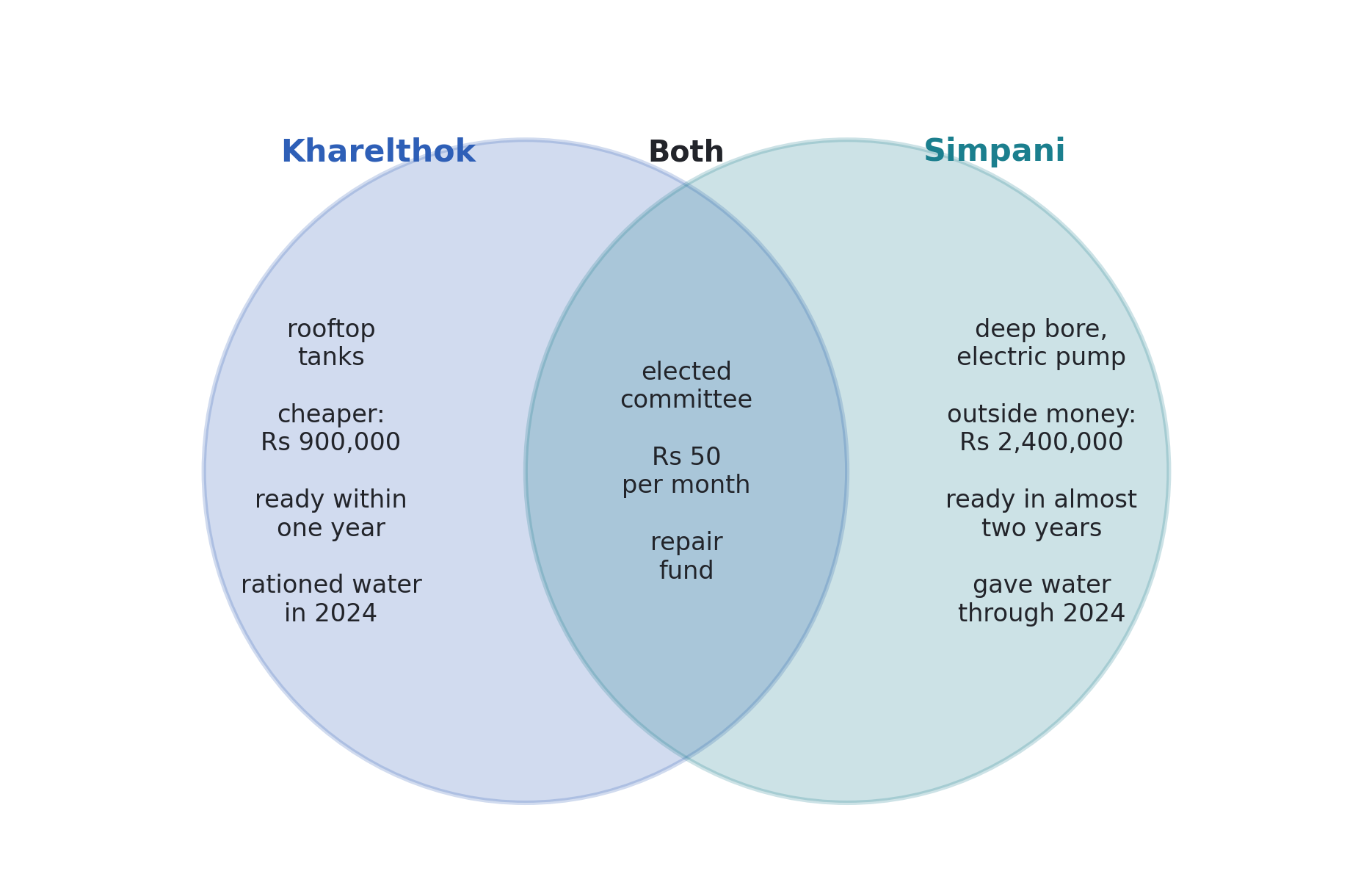
The same facts as a list. Only Kharelthok: rooftop tanks; cheaper, at Rs 900,000; ready within one year; rationed water in 2024. Only Simpani: a deep bore with an electric pump; outside money, Rs 2,400,000; ready in almost two years; gave water through 2024. Both: an elected committee; Rs 50 per month; a repair fund.
Idea 3: order of events has signal words too
A narrative tells events in time. Some writers keep a strict order; others jump backwards, so a reader must rebuild the order from clues. The strongest clues are dates and time signal words: first, then, next, two months later, meanwhile, by Dashain, finally. When two events share a date, the order between them comes from the story’s logic: a failed bore comes before the successful one that replaces it.
Idea 4: a timeline holds the order
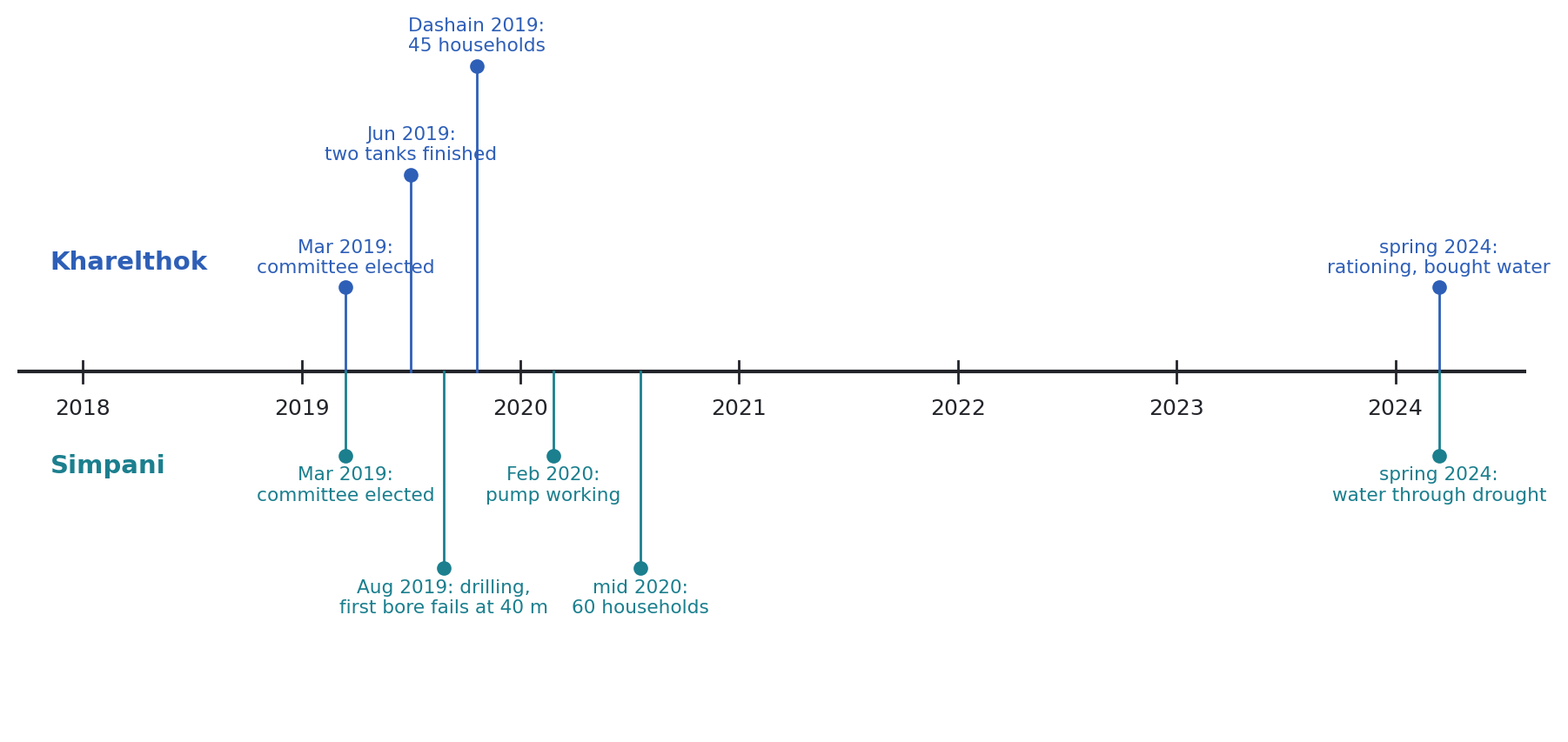
A timeline lays time along a line and pins events to it. When a text follows two threads at once, as ours follows two villages, give each thread its own lane. The result shows not only the order inside each story but also how the two stories moved at the same time.
Worked example 1: spotting the signal words
Which words signal likeness or difference in these two sentences? “Both villages elected water committees in March 2019.” “Whereas Kharelthok finished within a year, Simpani needed almost two.”
Name the signal, then the relationship: both applies the same fact to the two villages, so it signals a likeness: they started the same way. Whereas sets the two side by side as opposites, so it signals a contrast: one was fast, the other slow. Signal words do not carry the facts themselves; they tell you how the facts relate.
Your turn A: in “Unlike the tanks, the bore gave water through the 2024 drought”, which word signals a contrast, and what two things does it contrast?
Check your attempt
Explanation: unlike signals the contrast. It contrasts the bore with the tanks: the bore kept working in the drought, the tanks did not.
Worked example 2: placing a fact in the Venn diagram
Where does this fact belong: “The committees charge households Rs 50 per month”?
Test each side: is it true of Kharelthok? Yes. Of Simpani? Yes. A fact true of both goes in the overlap. The text even gives the signal word both for this one. A fact true of only one side, like “the first bore failed at 40 metres”, belongs in Simpani’s outer part, because the text never says Kharelthok drilled anything.
Your turn B: place this fact: “needed money from outside the village”.
Check your attempt
Explanation: Simpani’s outer part. Its Rs 2,400,000 came mostly from the municipality and a donor, while Kharelthok’s Rs 900,000 was collected inside the village.
Worked example 3: ordering events with dates
Put these three events in order: the pump starts working; drilling starts; the second bore finds water at 85 metres.
Pin each event to its date: drilling started in August 2019; the second bore found water two months later, so around October 2019; the pump started in February 2020. Order: drilling, second bore, pump. Dates are the strongest ordering clues a text can give, so harvest them first.
Your turn C: which came first, the two tanks being finished or the pump starting work?
Check your attempt
Explanation: the tanks, finished in June 2019; the pump started in February 2020, eight months later. The timeline shows the same fact at a glance.
Worked example 4: building a timeline for one village
Build the Kharelthok lane of the timeline from the text.
Harvest the dates in reading order, then place them in time order: March 2019, committee elected (given in the first paragraph, shared with Simpani); June 2019, two 20,000-litre tanks finished; by Dashain 2019, 45 households connected; spring 2024, rationing and six weeks of bought water. The first event comes from an earlier paragraph than the drought, but time, not paragraph order, decides the lane.
Worked example 5: contrast without a signal word
“Kharelthok spent Rs 900,000. Simpani spent Rs 2,400,000.” There is no whereas here. Is this still a contrast?
Compare the numbers: yes. Two parallel sentences about the same measure invite the reader to compare, and the numbers do the work: Simpani spent well over twice as much. Signal words are help, not a requirement; when none appears, ask whether the sentences still place two things side by side.
Interactive practice programs
Independent practice
Answer on paper from the practice text. Open each explanation only after your own attempt.
P1. In “Both sat on the same dry ridge, and both depended on old springs”, which word signals likeness, and how many times does it appear?
Check your attempt
Explanation: both, twice. Repetition strengthens the point: the two villages began from the same situation, which makes their later choices more interesting to compare.
P2. In “Unlike the bore, however, the tanks depend on the monsoon”, find the two signal words and say what each does.
Check your attempt
Explanation: unlike marks the contrast between tanks and bore; however marks the turn from the previous sentence, where the tanks looked better. Two signals can work together in one sentence.
P3. Where in the Venn diagram does “keeps a small repair fund” belong, and how do you know?
Check your attempt
Explanation: in the overlap. The text says both systems keep a repair fund, with the signal word both.
P4. Place “ready within a year” in the Venn diagram.
Check your attempt
Explanation: Kharelthok’s outer part. Its tanks were finished in June 2019, within a year of the March election, whereas Simpani’s bore needed from August 2019 to February 2020.
P5. Place “rationed water during the 2024 drought” in the Venn diagram.
Check your attempt
Explanation: Kharelthok’s outer part. The text says Kharelthok rationed to two hours a day, while the bore gave water through the whole drought.
P6. Put these Simpani events in order: the pump begins lifting water; the first bore fails at 40 metres; 60 households are served; the second bore finds water.
Check your attempt
Explanation: first bore fails (August 2019); second bore finds water (two months later); pump begins (February 2020); 60 households served (by the middle of 2020). The dates and two months later fix the order.
P7. Which signal words in the Simpani paragraph mark time, and which mark the turn in the story?
Check your attempt
Explanation: time: in August 2019, two months later, finally, in February 2020, by the middle of 2020. The turn: but in “but the first bore failed”, which signals the plan going wrong before it succeeded.
P8. True or false, and why: “The two villages elected their committees in different months.”
Check your attempt
Explanation: false. Both elected committees in March 2019, which is exactly why their later speeds make a fair comparison.
P9. The text says the tanks cost Rs 900,000 and the bore system Rs 2,400,000. About how many times larger was the bore system’s cost, and which Venn region does this fact illuminate?
Check your attempt
Explanation: 2,400,000 ÷ 900,000 is about 2.7, so well over twice as much. Each cost belongs to its own side of the diagram; comparing the two numbers is a contrast between the sides.
P10. “By Dashain that year, 45 households had connected their own pipes.” Which two words work together to place this event in time?
Check your attempt
Explanation: by and the festival name Dashain, with that year pointing back to 2019. Nepali texts often date events by festivals; treat a festival name as a date clue.
P11. A classmate says: “Kharelthok’s choice was better, because it was cheaper.” Does the practice text support this as a settled fact?
Check your attempt
Explanation: no. The text reports the cheaper cost as fact, but it also reports that the tanks failed in the drought while the bore did not. Better is a judgment, and the chairperson’s closing comment suggests each village had only half an answer. Keep facts and judgments separate, as the earlier lesson on fact and opinion taught.
P12. In one or two sentences, explain what the overlap of a Venn diagram and a lane of a timeline each show, using the practice text.
Check your attempt
Explanation: the overlap shows what two compared things share, such as both villages charging Rs 50 per month; a timeline lane shows one story’s events in time order, such as Simpani’s failed bore, successful bore and pump between August 2019 and February 2020.
Check, return and extend
Exit check
Close the lesson. Answer on paper, then compare with the panel.
E1. Name two signal words for likeness and two for difference.
E2. In a Venn diagram, where does “both keep a repair fund” go?
E3. From the practice text: which came first, Kharelthok’s finished tanks or Simpani’s working pump, and which dates prove it?
E4. Give one likeness and one difference between the two water systems, each with the signal word the text uses, if it uses one.
Check the exit questions
E1: likeness: both, similarly (also likewise, in the same way); difference: unlike, whereas (also however, while, on the other hand). E2: the overlapping middle, because it is true of both systems. E3: the tanks, finished in June 2019; the pump started in February 2020. E4: likeness: both are run by elected committees (or both charge Rs 50 per month, both keep a repair fund), signalled by both; difference: the tanks were cheaper and ready within a year whereas the bore needed almost two years and more money (signalled by whereas), or the tanks depend on the monsoon unlike the bore (signalled by unlike).
Return review
Tomorrow: without rereading, write one sentence about the two villages using both and one using whereas. Then check them against the fourth paragraph.
In about one week: from memory, list Simpani’s four events in order with their dates. Check against your timeline, not by rereading the paragraph first.
In a later writing lesson: you will write your own comparison paragraph, using at least one signal of likeness and one of difference. Collect two or three candidate pairs now (two festivals, two players, two apps) so the writing lesson starts with material ready.
The timing can be adjusted to the learner and timetable. The point is to retrieve the skill after a delay, not to earn a streak.
Extend beyond the lesson
Take any news report about two places, teams or products. Underline its comparison signals in one colour and its time signals in another, then draw a two-circle Venn diagram or a short timeline, whichever the text invites. Texts that do both at once, like ours, are common in reports and exam passages, so this double reading is worth practising until it feels ordinary.
Sources and limits
The explanations, the practice text, the diagrams, the interactive trainer and the questions are original. No textbook passage, literary work or examination paper is reproduced. The skills taught follow the Grade 11 reading outcomes of the official Secondary Education (Grade 11 & 12) Curriculum, 2077 (English, section 3.3): comparing and contrasting ideas, identifying the order of events and reading graphic organisers such as Venn diagrams and timelines. The prescribed reading texts themselves live in the official textbook, which this lesson does not replace.
This is not an official paper, teacher-endorsed course or complete unit. Inference and literature reading need their own lessons. Spaced review is informed by the IES learning practice guide; the suggested timing is not an optimal schedule proven for every learner. This material has not been reviewed by a qualified NEB teacher.
Revision ENG11-R3 · Consistency checked · 21 November 2026.